Website SEO Checklist for New Blogs (Step-by-Step Guide for 2026)
Launching a new website is easy. Building one that ranks consistently, attracts the right visitors, and grows over time is not.
This website SEO checklist is a complete, up-to-date blueprint for new blogs, creators, freelancers, and small businesses that want to build organic traffic correctly from day one. It avoids shortcuts and focuses on sustainable SEO fundamentals aligned with how search engines work today.
By the end of this guide, you will understand how to: – Build a technically sound website – Structure content for topical authority – Choose keywords you can realistically rank for – Optimize pages for users and search engines – Measure progress without guessing
This guide reflects current SEO best practices for 2026, with comparisons, examples, and visual aids placed exactly where they add clarity.
Table of Contents
- What Is Website SEO?
- Why SEO Matters for New Blogs
- Technical SEO Foundation
- Website Structure & Content Silos
- Keyword Research for Beginners (2026 Framework)
- On-Page SEO Optimization
- Content Strategy That Builds Authority
- Website Speed, UX & Core Web Vitals
- SEO Tools: Comparisons & Use Cases
- Tracking SEO Performance
- Common SEO Mistakes to Avoid
- 30-Day SEO Action Plan
- Final Website SEO Checklist
What Is Website SEO?
Website SEO (Search Engine Optimization) is the process of optimizing a website so search engines can easily crawl, understand, and rank its pages while providing the best possible experience to users.
Modern SEO is not about manipulating algorithms. It is about clarity, structure, speed, usefulness, and trust.
Search engines aim to recommend the best possible result for a query. Your job is to make that recommendation obvious.
Why SEO Matters for New Blogs
SEO compounds over time. Each optimized page becomes a long-term asset.
Benefits of SEO for new blogs include: – Predictable traffic growth – Reduced dependence on paid ads – Higher trust and credibility – Better monetization opportunities
Skipping SEO early often results in poor architecture, thin content, and slow performance—issues that are difficult to fix later.
Technical SEO Foundation
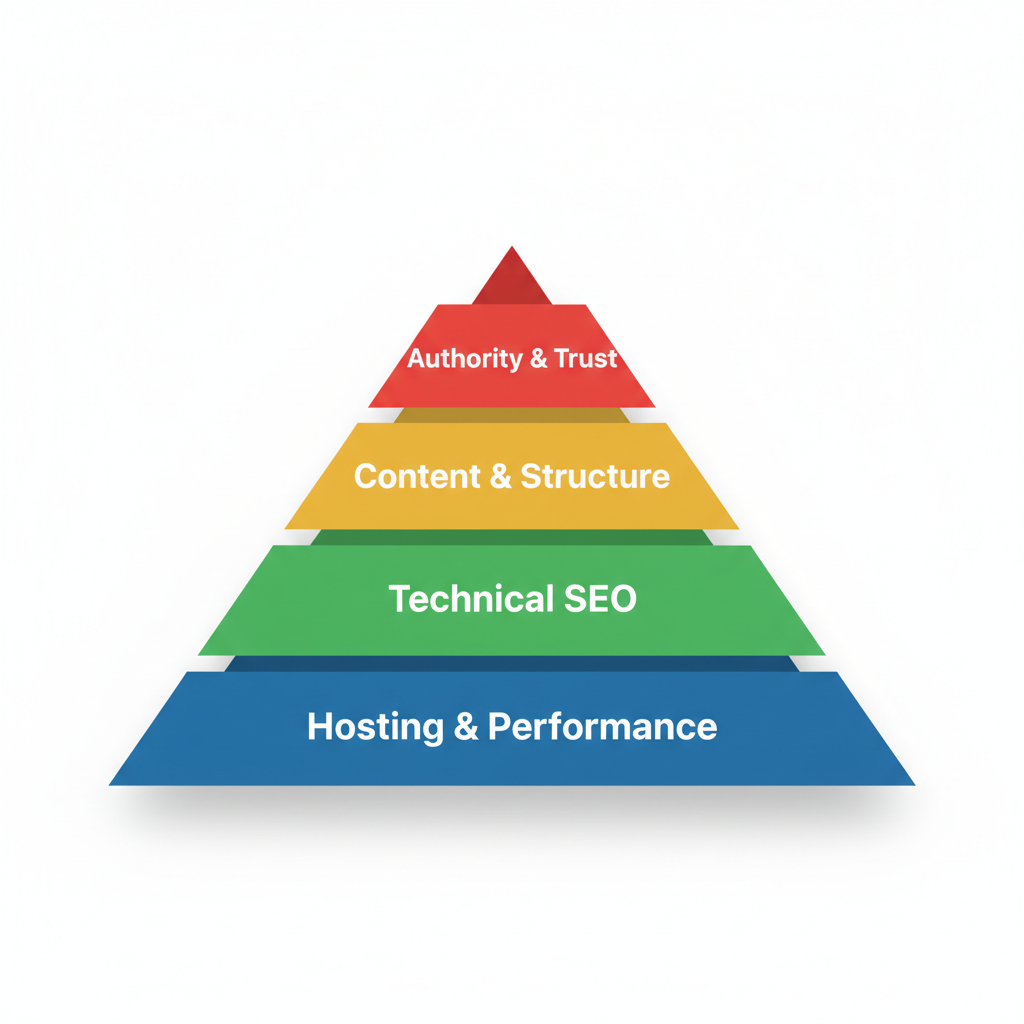
Technical SEO is the base layer of your website. Without it, content struggles to perform.
SEO Foundation Pyramid
Hosting Selection (Comparison)
Your hosting directly affects speed, uptime, and crawl-ability.
Hosting Comparison Table
| Feature | Budget Hosting | Optimized Hosting |
| Speed | Slow | Fast |
| Uptime | Inconsistent | 99.9%+ |
| SEO Impact | Negative | Positive |
| Scalability | Limited | Flexible |
Choose hosting optimized for performance, not just price.
WordPress Installation Best Practices
- Clean installation
- Latest PHP version
- Minimal plugins
- Lightweight theme
Avoid bloated themes and page builders early.
HTTPS, Indexing & Crawl Control
- Enable SSL
- Verify indexing status
- Review robots.txt
- Set canonical URLs
Expert Tip: Many ranking problems come from mis-configured indexing—not content.
Website Structure & Content Silos
Structure determines how search engines interpret topical authority.
Best Practices
- One pillar per topic
- Supporting cluster content
- Internal links between related pages
- Clear navigation hierarchy
A strong structure improves rankings and user engagement.
Keyword Research for Beginners (2026 Framework)
Keyword research identifies what people search for and how competitive those searches are.
Beginner Strategy
- Target long-tail keywords
- Analyze SERPs before writing
- Match intent precisely
- Build clusters, not single pages
Good vs Bad Keyword Example
| Keyword | Intent | Difficulty | Verdict |
| “best seo tools” | Commercial | High | Avoid early |
| “best seo tools for new blogs” | Commercial | Low | Target |
On-Page SEO Optimization
On-page SEO clarifies your content for search engines.
Checklist
- One H1 per page
- Clear H2/H3 structure
- Optimized title tags
- Compelling meta descriptions
- Internal linking
- Image alt text
Content Strategy That Builds Authority
Content quality is the strongest ranking signal over time.
What Works in 2026
- Long-form depth
- Experience-based insights
- Visual explanations
- Regular updates
Website Speed, UX & Core Web Vitals
Speed and usability directly affect rankings and conversions.
Performance Metrics Explained
- LCP: Loading speed
- INP: Interactivity
- CLS: Visual stability
Speed Optimization Table
| Optimization | Impact |
| Quality hosting | High |
| Image compression | Medium |
| Caching | High |
| Lightweight theme | High |
SEO Tools: Comparisons & Use Cases
SEO tools help analyze, track, and optimize.
Tool Comparison Table
| Tool Type | Best For | Cost |
| Keyword research | Planning | Paid |
| Site audit | Technical SEO | Free/Paid |
| Rank tracking | Monitoring | Paid |
Use tools as decision aids—not replacements for strategy.
Tracking SEO Performance
Track progress using: – Google Search Console – Analytics platforms
Common SEO Mistakes to Avoid
- Publishing thin content
- Chasing volume over intent
- Ignoring site speed
- Over-optimizing keywords
- Buying low-quality backlinks
30-Day SEO Action Plan
Week 1: Technical setup Week 2: Keyword research Week 3: Content creation Week 4: Optimization & tracking
Final Website SEO Checklist
✔ Fast hosting ✔ Clean structure ✔ Proper keyword targeting ✔ Optimized content ✔ Performance tracking ✔ Continuous updates
SEO rewards consistency and clarity. Done correctly, it becomes a sustainable growth engine.